SpyderBot · January 18, 2026 · Press
Best Buy Holds Strong AI Visibility, but Amazon and Walmart Are Winning the “Fast and Affordable” Story
SpyderBot’s GEO report shows that Best Buy remains highly visible in expert-led electronics prompts, but generative AI systems increasingly favor Amazon for speed, Walmart for value and B&H Photo Video for specialist product authority.
View bestbuy.com's Full GEO (Generative Engine Optimization) Report
AI search is changing how consumers choose where to buy electronics.
A shopper no longer needs to open Google, compare product pages and read five retail websites before making a decision. They can ask ChatGPT, Gemini, Copilot or Perplexity:
“Where should I buy a new OLED TV with installation?”
“Who has the fastest same-day tech delivery?”
“Where can I find an affordable school laptop?”
“Which retailer is best for professional camera lenses?”
In those moments, AI does more than return links.
It interprets retailers.
It compares strengths.
It decides which brands deserve to appear in the answer.
A SpyderBot GEO report for BestBuy.com shows that Best Buy still owns meaningful AI shelf space, especially when prompts involve technical support, installation, trade-ins and premium electronics.
But the same report reveals a clear strategic risk: Best Buy’s expert positioning is strong, while its speed and value narratives are less consistently reinforced inside AI-generated answers.
That matters because AI visibility is not only about whether a brand appears.
It is about which version of the brand AI chooses to show.
Best Buy has strong AI shelf space, but not category control
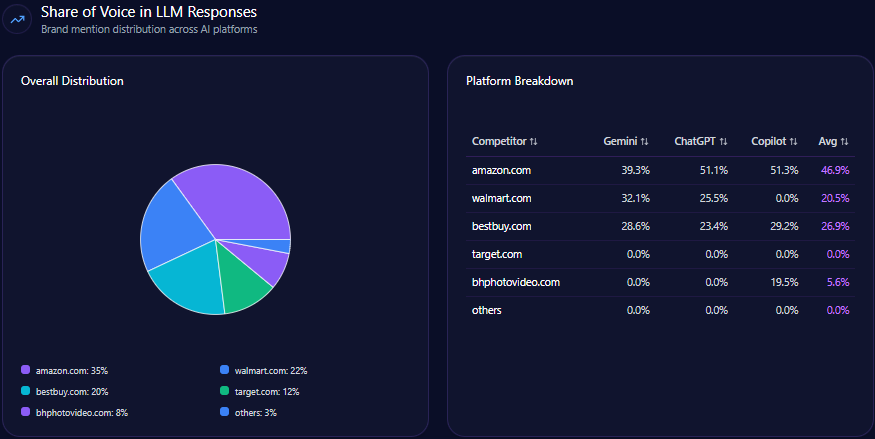
According to the SpyderBot report, Best Buy holds 20% Share of Voice across tracked LLM brand mentions, with 105 mentions out of 523 total mentions.
Overall visibility performance across platforms
The brand also records:
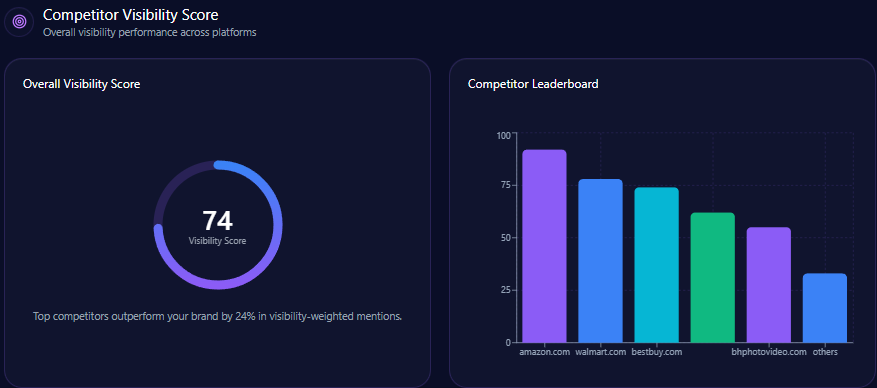
- 74 Visibility Score
- 92 Rank Score in premium electronics positioning
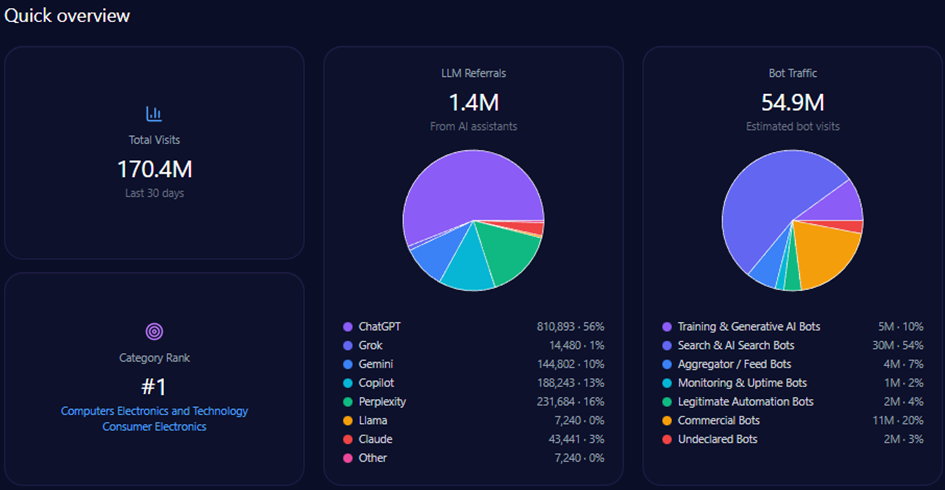
- 170,355,633 total visits
- 54,854,514 bot traffic visits
- 1,448,023 LLM referrals
- #1 category rank in Computers, Electronics and Technology / Consumer Electronics
Those numbers show that Best Buy is not invisible in generative search.
It has scale.
It has authority.
It has strong association with premium electronics and technical service.
But the competitive picture is not evenly distributed.
Amazon leads overall AI Share of Voice with 35% and a 92 Visibility Score. Walmart follows with 22% Share of Voice and a 78 Visibility Score. Best Buy sits behind both in total visibility, even while holding stronger expert-led positioning in several high-value prompts.
The central insight is simple:
Best Buy is strong when the question requires help. It is weaker when the question asks for speed or low price.
That is the story-shape problem Best Buy needs to solve.
Where Best Buy still feels like the expert
Best Buy performs best when AI prompts imply service, expertise or complex decision-making.
In ranked response lists, Best Buy appears strongly in categories such as expert electronics retail, Apple product support, trade-ins, home cinema and professional installation.
On ChatGPT, Best Buy appears at rank #2 in “Expert Electronics Retailers,” where it is framed as a leading physical retailer for Apple product support and trade-ins.
It also holds rank #2 in “Home Cinema Specialists,” where AI answers connect the brand with high-end installation and OLED expertise.
On Copilot, Best Buy ranks #3 in “Omnichannel Retail,” with visibility tied to in-store pickup and physical retail convenience.
These are meaningful advantages.
They show that AI systems understand Best Buy as more than an online electronics seller. The brand is associated with service, support, advice, installation and in-person help.
That is difficult for online-only competitors to copy.
However, the same dataset shows that this advantage becomes conditional when prompts shift toward convenience, fast shipping or budget-led product discovery.
On Gemini, Amazon ranks #1 in “General Merchandise Leaders” and “Smart Home Integration.” In appliance-related prompts, Best Buy remains present, but appears lower when pricing for small appliances becomes part of the answer.
This is where Best Buy’s AI visibility starts to split.
The brand is credible.
But it is not always the default.
The competitive gaps are concentrated around speed, value and specialist authority
The SpyderBot report identifies several quantified gaps where competitors outperform Best Buy in specific prompt categories.
The most immediate pressure point is delivery speed.
For the prompt “fastest same day tech delivery,” Best Buy scores 76, while Amazon scores 98. That 22-point gap shows that AI systems still heavily associate Amazon with speed, fast fulfillment and delivery reliability.
This does not mean Best Buy lacks pickup or fulfillment capabilities.
It means AI does not cite those advantages strongly enough when the prompt is framed around speed.
A second gap appears in professional camera and lens prompts.
For “professional camera lens comparisons,” Best Buy scores 72, while B&H Photo Video scores 95. The report suggests that B&H is treated as the stronger default for deep technical specifications and professional photography authority.
The education layer widens the gap further. In “live photography workshops,” Best Buy scores 45, while B&H scores 91.
A third gap appears in budget smart home prompts.
For “best budget smart home hub,” Best Buy scores 68, while Walmart scores 91.
This shows that value language is pulling AI recommendations toward generalist retailers with stronger low-price associations.
At the same time, Best Buy has clear areas of advantage.
In “custom home theater wiring,” Best Buy scores 89, compared with Target at 52. This is a 37-point advantage and shows where Geek Squad and installation-led authority can still win decisively.
The broader lesson is clear:
Best Buy wins when the prompt asks for expertise. Competitors win when the prompt asks for speed, budget or specialist depth.
Trigger keywords are quietly handing competitors the microphone
High-value keywords driving e-commerce mentions
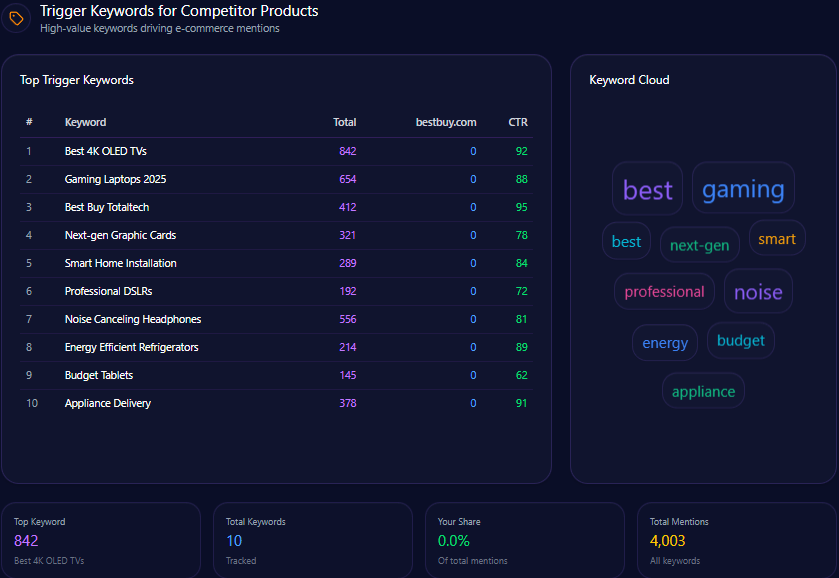
One of the most important findings in the report is how strongly trigger keywords shape AI brand mentions.
In AI search, the words users choose can change which retailers appear.
For broad product-led prompts, Amazon often dominates.
In “Noise Canceling Headphones,” Amazon is associated with 1,240 mentions, followed by Walmart with 682 and Target with 412.
In “Budget Tablets,” Amazon appears with 892 mentions, Walmart with 712 and Target with 456.
These are not small differences. They show that broad product and budget language routes AI attention toward generalist retailers.
Professional terms create a different pattern.
In “Professional DSLRs,” B&H Photo Video leads with 612 mentions, ahead of Amazon with 388. This shows that specialist language can shift AI recommendations away from mass retailers and toward category experts.
Some keywords still belong strongly to Best Buy.
“Best Buy Totaltech” is tracked at 412 mentions, while Amazon appears at 12 and Walmart at 5.
That is an important clue.
Owned service-language can still create defensible AI visibility when it is specific enough.
For Best Buy, the opportunity is to expand those owned associations beyond Totaltech and Geek Squad into clearer prompt clusters around:
- same-day pickup
- expert setup
- high-end home theater
- trade-in value
- premium electronics support
- in-store demos
- reliable installation
This is not just keyword optimization.
It is brand positioning for AI-generated answers.
Founder and leadership narratives are quiet, not negative
The report also tracks founder and leadership context in AI-generated answers.
Richard Schulze appears with a mention frequency of 21, compared with 137 for Jeff Bezos and 86 for Sam Walton.
His sentiment is not weak. Schulze carries a sentiment score of 74, with 68% positive sentiment, 28% neutral sentiment and 4% negative sentiment.
The issue is visibility.
The founder narrative is largely confined to historical archives rather than modern retail innovation narratives.
That creates a subtle GEO gap.
Competitors use founder legacies as shorthand for innovation, disruption, scale or retail philosophy. Best Buy’s founder story is not negative, but it is not actively shaping current AI conversations about the future of retail.
The report also shows negative founder-context themes across the competitive set, especially labor relations, market dominance and executive compensation. Labor relations account for the largest share at 42%, followed by market dominance at 33% and executive compensation at 25%.
In Best Buy’s case, AI conversations referencing layoffs triggered a 14% spike in labor relations negative context, reducing founder-led sentiment in Copilot responses.
This does not mean founder narrative should become the center of Best Buy’s GEO strategy.
But it does show that AI systems are sensitive to leadership and corporate storyline spikes.
For a retailer with Best Buy’s service-led positioning, stronger executive content around workforce expertise, customer support, technical training and the future of human-assisted retail could help strengthen the brand’s interpretation layer.
Bot traffic and LLM referrals show why this matters now
Best Buy’s GEO footprint is not theoretical.
The report tracks 170,355,633 total visits and 54,854,514 bot traffic visits.
Within bot traffic, Search and AI Search Bots account for 29,621,437 visits, while Training and Generative AI Bots account for 5,485,451.
This matters because the systems shaping tomorrow’s AI answers are already crawling today’s pages.
LLM referrals total 1,448,023, led by:
- ChatGPT: 810,893
- Perplexity: 231,684
- Copilot: 188,243
- Gemini: 144,802
- Claude: 43,441
- Grok: 14,480
Best Buy also ranks #1 in Computers, Electronics and Technology / Consumer Electronics.
That category leadership should translate into AI authority.
The report suggests that it does, but unevenly.
Best Buy is structurally built to win expert-led queries.
It must fight harder when the prompt is cheap, fast or product-only.
The mindshare math: Amazon leads, Walmart pressures value, Best Buy owns expertise
In overall Share of Voice, Best Buy holds 20% of tracked LLM brand mentions.
Amazon leads with 35%. Walmart follows with 22%. Target holds 12%, while B&H Photo Video holds 8%.
Visibility Score tells a similar story.
Amazon leads with 92. Walmart follows with 78. Best Buy sits at 74, ahead of Target at 62 and B&H Photo Video at 55.
That position is strong, but not dominant.
Amazon’s advantage is built on breadth, speed and convenience. Walmart’s advantage is tied to price and value. B&H’s advantage appears in specialist product authority. Best Buy’s advantage is strongest where users need help, technical confidence or installation support.
Best Buy’s opportunity is not to become Amazon.
It is to become the default answer for:
“I want it right, now, and I want help.”
Then it needs to stretch that authority into value language without losing the expert halo.
Same brand, different AI outcomes
Best Buy does not perform the same way across every AI platform.
On Gemini, Best Buy reaches 23% visibility and 40 mentions out of 175 total. Amazon holds 31%, while Walmart holds 26%.
The report suggests Gemini visibility benefits from local inventory signals, an area where Best Buy is structurally strong.
On ChatGPT, Best Buy holds 19% visibility, with 32 mentions out of 170 total. Amazon rises to 41%, while Walmart reaches 21%.
This suggests that ChatGPT answers lean more strongly toward generalist breadth and convenience narratives.
On Copilot, Best Buy also holds 19% visibility, with 33 mentions out of 178 total. Amazon leads with 33%, but Copilot also surfaces B&H Photo Video at 12%, showing that specialist authority can punch above scale in technical contexts.
The implication is important.
There is no single AI search market.
The same brand can be interpreted differently by each platform.
Best Buy appears as a local authority on Gemini, a credible expert but not the default on ChatGPT, and a retailer competing with specialists on Copilot.
That is why platform-level tracking matters.
Sentiment shows trust is not the problem
The report’s competitor sentiment tracking shows that Best Buy is not losing the trust argument.
Best Buy records a sentiment score of 78, with 68 positive, 21 neutral and 11 negative.
B&H Photo Video leads with a sentiment score of 85. Amazon follows at 81. Best Buy and Target both sit at 78. Walmart trails at 73.
The difference is not simple positivity.
It is narrative tone.
The report identifies four major context themes:
- Technical Support and Repair: 52 mentions
- Price and Value: 41 mentions
- Logistics and Fulfillment: 33 mentions
- Product Expertise: 24 mentions
Technical Support and Repair is mostly positive, with terms such as Geek Squad, diagnostic, repair service and warranty.
Product Expertise is also positive.
Price and Value is mixed, with terms such as price match, expensive, deals and membership cost.
This is the pressure zone.
Best Buy is trusted.
But its value story is contested.
That is exactly where Walmart’s narrative naturally becomes stronger.
The prompts that most reliably summon Best Buy
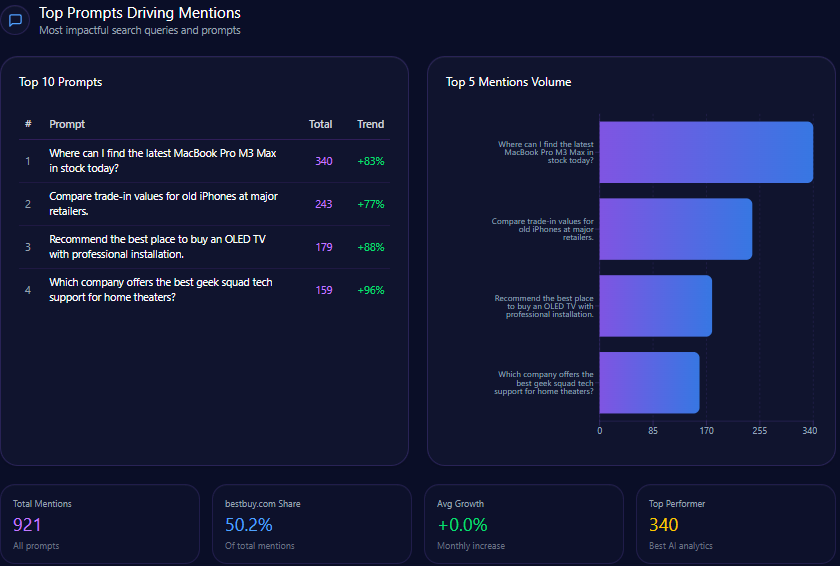
The report’s top prompt list shows where Best Buy is most likely to appear.
For “Where can I find the latest MacBook Pro M3 Max in stock today?” the prompt generated 340 mentions. Best Buy earned 108 mentions, with Amazon and B&H Photo Video also appearing as competitors.
For “Compare trade-in values for old iPhones at major retailers,” the prompt generated 243 mentions. Best Buy earned 91 mentions.
For “Recommend the best place to buy an OLED TV with professional installation,” the prompt generated 179 mentions. Best Buy earned 122.
For “Which company offers the best Geek Squad tech support for home theaters?” the prompt generated 159 mentions. Best Buy earned 141.
These prompts reveal the strongest Best Buy blueprint:
- in-stock urgency
- trade-in clarity
- professional installation
- Geek Squad authority
- premium electronics confidence
When the question implies complexity, Best Buy becomes the answer.
The challenge is to make that strength travel into budget, speed and everyday consumer electronics prompts.
E-commerce discovery shows the same split
In ecommerce-oriented AI discovery, Best Buy holds 13.15% Share of Voice with 1,135 mentions across ChatGPT, Gemini and Copilot.
Amazon leads with 38.68% and 3,340 mentions. Walmart follows with 19.91% and 1,719 mentions. Target holds 10.02%, while B&H Photo Video holds 5.1%.
The ecommerce layer confirms the broader story.
Best Buy performs well when service, pickup and high-end product confidence matter.
Amazon dominates where breadth, reviews and shipping expectations matter.
Walmart gains ground where affordability and value shape the prompt.
The report also records referral performance in ecommerce contexts, with Gemini showing 10,200 referrals, ChatGPT 8,450 and Copilot 7,820.
This shows that AI discovery can influence real ecommerce behavior, not just brand perception.
What retailers can learn from Best Buy
Best Buy’s GEO profile shows a broader lesson for retail brands:
AI visibility is not one score.
It is a pattern across prompt types.
A retailer should not only ask:
“Are we mentioned by AI?”
It should ask:
“Which questions make AI choose us?”
“Which questions make AI choose a competitor?”
“Which words change the recommendation?”
“Which platform interprets us differently?”
“Which parts of our brand story are under-cited?”
Best Buy wins expert-led prompts.
Amazon wins speed and breadth.
Walmart wins affordability.
B&H wins professional depth.
That is the new competitive map of AI search.
SpyderBot AI Visibility Framework for Retail
A stronger GEO strategy for retail brands should track six layers:
1. Visibility
Does AI mention the brand?
2. Prompt context
Which user questions trigger the brand?
3. Competitors
Which retailers appear beside it?
4. Sentiment
Is the brand described positively, neutrally or negatively?
5. Source influence
Which sources shape the answer?
6. Opportunity
Which prompt clusters can the brand improve?
This framework helps retailers move from general visibility tracking to prompt-level competitive intelligence.
What Best Buy should do next
Based on the SpyderBot report, Best Buy should focus on five GEO priorities.
1. Strengthen same-day delivery and pickup signals
Amazon dominates speed narratives.
Best Buy should make same-day pickup, local availability, delivery windows and store-level inventory easier for AI systems to understand and retrieve.
2. Expand value-oriented content
Walmart pressures Best Buy in budget and affordability prompts.
Best Buy should create more AI-readable content around price match, Best Buy Essentials, student tech, budget laptops, affordable smart home devices and value bundles.
3. Improve professional camera and technical specification content
B&H Photo Video wins professional camera and lens prompts.
Best Buy should strengthen structured content around camera specs, lens compatibility, pro workflows, comparison guides and buying advice for creators.
4. Turn Geek Squad into a stronger AI authority asset
Geek Squad is one of Best Buy’s most defensible advantages.
Best Buy should publish more sourceable content around diagnostics, repair, installation, hardware reliability, home theater setup and technical support outcomes.
5. Make expert-led prompts connect to ecommerce
Best Buy already wins when prompts involve service and expertise.
The next step is connecting those answers to clear product availability, purchase paths, pickup options, trade-ins and installation packages.
GEO checklist for electronics retailers
Before trusting your AI visibility, ask:
☐ Does AI mention your brand in your core retail category?
☐ Which prompts trigger your brand most often?
☐ Which prompts trigger Amazon, Walmart or specialist competitors?
☐ Does AI describe your value proposition accurately?
☐ Are your delivery and pickup signals visible to AI systems?
☐ Are budget product lines clearly explained?
☐ Are expert services supported by sourceable content?
☐ Are technical product specifications structured clearly?
☐ Is sentiment improving or becoming mixed?
☐ Are you winning purchase-intent prompts, or only awareness prompts?
If you cannot answer these questions, your AI visibility is still incomplete.
Final takeaway
Best Buy does not have an awareness problem in AI search.
It has a story-shape problem.
The brand is highly visible when the question is technical, service-led, installation-heavy or premium.
But it becomes more fragile when the prompt is driven by speed, affordability or deep professional specifications.
That is the core shift from SEO to GEO.
In traditional SEO, retailers compete for rankings.
In generative search, retailers compete for interpretation.
The brands that win will be the ones that make their strengths easy for both customers and AI systems to understand.
For Best Buy, the question is no longer only:
“Do we rank in electronics?”
It is:
“When shoppers ask AI where to buy, does AI choose our story—or a competitor’s?”
FAQ
What is AI visibility for retail brands?
AI visibility measures how often and how accurately a retail brand appears in AI-generated answers across platforms such as ChatGPT, Gemini, Copilot, Perplexity, Claude and Grok.
What is GEO?
GEO, or Generative Engine Optimization, is the process of improving how a brand appears in AI-generated answers.
What did SpyderBot find about Best Buy?
SpyderBot found that Best Buy has strong AI visibility in expert-led electronics prompts, especially around installation, support, trade-ins and premium products. However, Amazon leads in speed and breadth, Walmart pressures value prompts, and B&H Photo Video wins specialist professional gear prompts.
Why does prompt-level visibility matter?
Prompt-level visibility matters because AI recommendations change depending on how a shopper asks the question. A brand may win expert prompts but lose budget, delivery or specialist product prompts.
Which competitors challenge Best Buy in AI search?
Amazon challenges Best Buy in speed, shipping and general product breadth. Walmart challenges Best Buy in affordability and value narratives. B&H Photo Video challenges Best Buy in professional camera and lens authority. Target appears in broader retail comparisons.
How can electronics retailers improve AI visibility?
Electronics retailers can improve AI visibility by strengthening structured product data, improving local inventory signals, publishing clearer comparison content, supporting expert service claims with sourceable content and monitoring prompt-level performance across AI platforms.
Tags: AI Citations, AI Search, AI visibility, amazon.com, Best Buy, bestbuy.com, bhphotovideo.com, Brand Mentions, Competitor Analysis, generative engine optimization, GEO, LLM Monitoring, Share of Voice, target.com, walmart.com