SpyderBot · January 2, 2026 · Press
Workable Leads in AI Recruiting Visibility, but Full Suite HR Rivals Are Closing the Gap
SpyderBot’s 2026 GEO report shows that Workable has strong authority in AI-powered recruiting, but BambooHR, Lever and Teamtailor are gaining ground in broader HR suite, integration and employer branding prompts.
AI search is changing how HR software buyers discover and compare recruiting platforms.
A hiring manager no longer needs to start with Google, open ten vendor pages and manually compare product claims.
They can ask ChatGPT, Gemini, Copilot, Grok or Perplexity:
“What is the best AI recruiting software for a mid-sized company?”
“Which ATS is better for collaborative hiring?”
“What are the best alternatives to Workable?”
“Which HR platform combines recruiting, onboarding and employee management?”
In those moments, AI does more than return links.
It interprets the market.
It compares vendors.
It decides which platforms deserve to appear in the shortlist.
That is why generative engine optimization, or GEO, is becoming a serious visibility layer for HR technology companies.
A SpyderBot GEO report for Workable.com shows that Workable remains highly visible in AI recruiting contexts. The brand is strongly associated with AI-powered candidate sourcing, job posting automation, applicant tracking and mid-market hiring efficiency.
But the same report also reveals a strategic risk: Workable’s AI recruiting authority does not automatically translate into dominance across broader HR suite and employer branding prompts.
That is where full-suite rivals are gaining ground.
Workable has strong AI visibility, but not complete category control
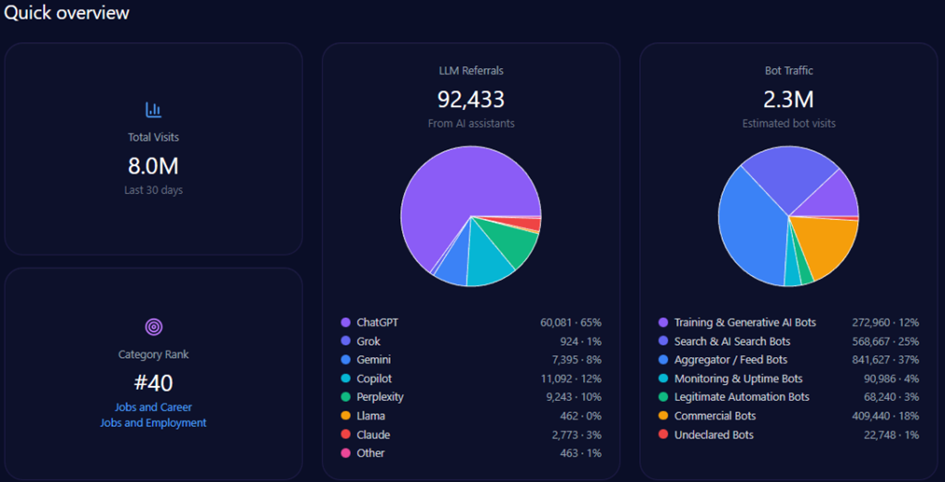
According to the SpyderBot report, Workable.com recorded 8,037,697 total visits, including 2,274,668 visits from bot traffic and 92,433 LLM referrals as of January 2, 2026.
The domain held a category rank of 40 in Jobs and Career / Jobs and Employment.
Across the analyzed GEO dataset, Workable reached:
- 19% Share of Voice
- 1,860 total mentions
- 82 visibility score
- 348 mentions in AI Recruiting Software contexts
- 99% visibility in Job Description Template Queries
These are strong signals.
They show that AI systems understand Workable as a major recruiting technology platform, especially when users ask about AI recruiting, hiring automation and job description generation.
However, the report also shows that Workable’s visibility is uneven.
In “Comprehensive HR Suite” contexts, Workable drops to 33% coverage, while BambooHR becomes more visible in lifecycle HR narratives.
That difference matters.
Recruiting software buyers do not always ask narrow ATS questions. Many ask broader questions about HR operations, employee lifecycle management, onboarding, integrations and full-suite platforms.
If AI interprets Workable mainly as a recruiting tool while interpreting BambooHR as a broader HR platform, Workable may win ATS prompts but lose suite-level buying prompts.
The main GEO insight: Workable wins AI recruiting, but BambooHR wins broader HR narratives
The strongest finding from the report is not that Workable is weak.
It is that Workable is specialized.
AI systems appear to associate Workable with:
- AI-powered candidate sourcing
- Recruiting workflow efficiency
- Job description templates
- Automated job postings
- Collaborative hiring
- Mid-market talent acquisition
That gives Workable a clear advantage in recruiting-specific prompts.
But full-suite competitors gain visibility when prompts shift toward:
- HRIS
- Employee lifecycle management
- Onboarding
- Workforce administration
- Full-suite HR technology
- Pricing and feature comparisons
- Employer branding
BambooHR leads the broader share-of-voice field with 25% and 461 mentions, compared with Workable’s 19% and 348 mentions in the competitive set. BambooHR also records a higher visibility score at 89, compared with Workable’s 82.
This does not mean BambooHR beats Workable in AI recruiting.
It means AI models may categorize the two brands differently.
That is the key lesson for HR technology marketers:
AI visibility is not one score. It is a pattern across different buyer intents.
A platform can dominate one intent and lose another.
Sentiment is positive, but BambooHR still leads on trust signals
Workable’s sentiment profile is strong.
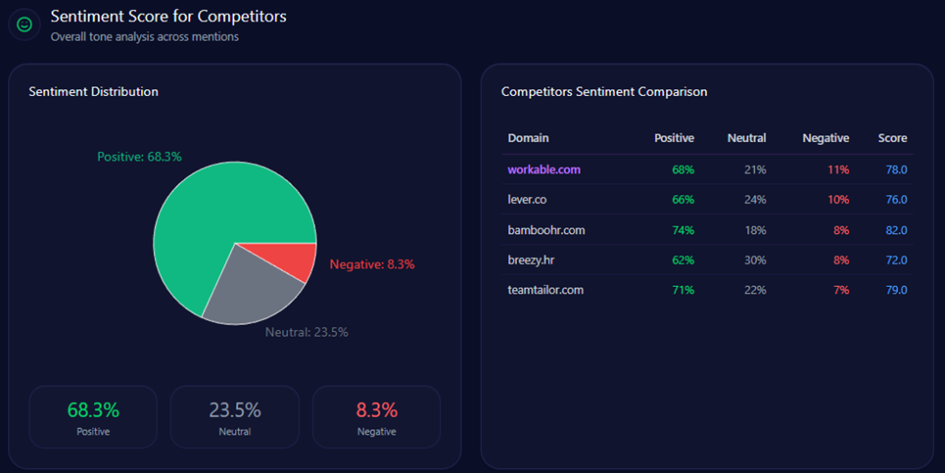
The SpyderBot report gives Workable an aggregate sentiment score of 78, with:
- 68% positive sentiment
- 24% neutral sentiment
- 8% negative sentiment
This suggests that AI-generated answers generally describe Workable favorably.
Positive themes include hiring efficiency, AI sourcing, mid-market scalability and recruiting automation.
However, Workable does not lead sentiment across the full competitive set.
BambooHR records a sentiment score of 83, with 78% positive sentiment and only 4% negative sentiment. Lever also performs slightly ahead of Workable with a sentiment score of 79.
This creates an important positioning challenge.
Workable appears strong when AI discusses recruiting efficiency.
BambooHR appears stronger when AI discusses broader HR trust, lifecycle support and suite-level stability.
For Workable, the opportunity is to build more AI-readable evidence around trust, ethics, integrations, onboarding and long-term HR value, not only recruiting speed.
Founder visibility is an underused GEO asset
The report also tracks founder-related sentiment and executive authority signals.
Nikos Moraitakis records a sentiment score of 74 across 78 mentions, with 68% positive, 21% neutral and 11% negative sentiment.
Spyros Magiatis records a sentiment score of 68 across 56 mentions, with 62% positive, 28% neutral and 10% negative sentiment.
These founder signals matter because AI systems do not only summarize product pages. They also interpret leadership narratives, interviews, investment stories, founder commentary and market positioning.
In Workable’s case, founder mentions are connected to AI ethics in hiring, strategic execution and company direction.
That creates an opportunity.
If Workable wants to strengthen its GEO footprint, founder-led content could help define how AI systems understand the company’s long-term position in ethical AI recruiting.
Instead of publishing only product-led content, Workable could benefit from more executive content around:
- Responsible AI in hiring
- Bias reduction in recruitment
- AI ethics for talent acquisition
- The future of ATS automation
- Mid-market hiring efficiency
- Human oversight in AI screening
This would help AI systems connect Workable not only with product features, but also with category leadership.
The biggest visibility gaps are not random
SpyderBot’s competitor gap analysis shows several areas where Workable faces pressure.
The report highlights:
- 17% share lag on Copilot against BambooHR
- 58% employer branding slip versus Teamtailor
- 33% coverage in comprehensive HR suite prompts
- Leadership visibility gap linked to limited recent founder interviews
- Pricing concerns in advanced-tier comparisons
- Product stagnation concerns around feature parity and implementation speed
These are not isolated issues.
They show where AI systems may be forming a less complete picture of Workable.
For example, if Teamtailor is repeatedly associated with visual employer branding, Workable may lose prompts where the user asks about candidate experience, career site design or employer brand storytelling.
If BambooHR is repeatedly associated with full-suite HR, Workable may lose prompts where the user wants one platform for hiring, onboarding and employee management.
If Copilot gives stronger visibility to BambooHR in suite-related answers, Workable may be less visible to business users searching through Microsoft’s AI ecosystem.
That is why prompt-level tracking matters.
A company may look strong in general AI visibility, while still losing the exact prompts that shape purchase decisions.
Funding and market narratives show momentum, but also consolidation risk
The report also tracks Workable’s funding and market narratives across time.
Workable’s funding-related visibility shows growth across the analyzed 2024 trend period:
- Q1 2024: 3% change, 1,134 mentions
- Q2 2024: 10% change, 1,248 mentions
- Q3 2024: -5% change, 1,192 mentions
- Q4 2024: 15% change, 1,367 mentions
This trend suggests that Workable maintains market momentum in AI-generated narratives.
However, negative founder and market contexts show areas that need monitoring.
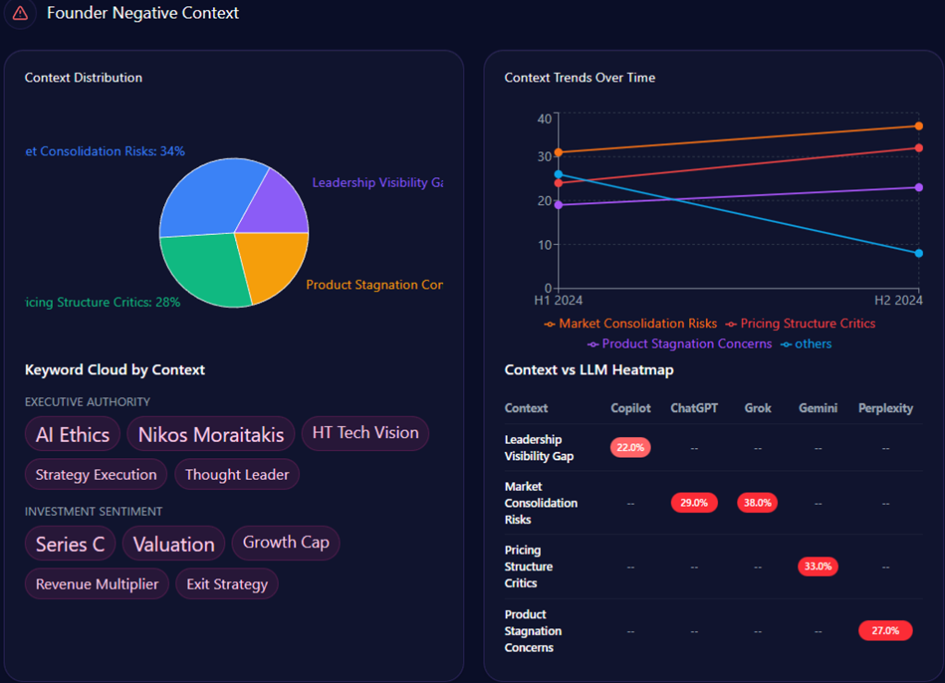
The report identifies four main negative context clusters:
- Market consolidation risks: 34%
- Pricing structure critics: 28%
- Product stagnation concerns: 21%
- Leadership visibility gap: 17%
Market consolidation risk is the largest concern, with themes such as acquisition rumors, independent growth questions and HR tech consolidation narratives.
Pricing concerns also increased in the second half of the trend period, moving from 24% in H1 to 32% in H2.
This matters because AI systems may surface those narratives when buyers ask comparison or vendor-risk questions.
For HR technology companies, negative context is not only a reputation issue. It can become a sales risk if AI mentions it during vendor evaluation.
Platform behavior shows where Workable should optimize first
The SpyderBot report shows that AI visibility differs by platform.
The report tracked 96 bots across ChatGPT, Grok, Gemini, Copilot and Perplexity, with 96 queries per platform. It also recorded 92,433 LLM referrals.
ChatGPT accounted for the largest share of LLM referrals at 60,081. Copilot followed with 11,092, while Gemini accounted for 7,395.
Workable performs strongly in Perplexity with 87% visibility, suggesting technical authority and strong source alignment.
However, Copilot shows a visibility gap where BambooHR’s broader suite positioning becomes more competitive.
This creates a clear prioritization path.
Workable should not optimize for “AI search” as one generic channel.
It should optimize by model, prompt type and buyer intent.
For example:
- ChatGPT may be important for general vendor discovery.
- Perplexity may be important for technical research and source-backed comparisons.
- Copilot may be important for business users inside Microsoft workflows.
- Gemini may be important for search-connected discovery and comparison prompts.
- Grok may surface broader market-risk and consolidation narratives.
That is why a GEO strategy needs platform-level visibility tracking, not only total brand mentions.
What HR tech brands can learn from Workable
The Workable report shows a broader lesson for HR technology brands:
AI visibility is not the same as brand awareness.
It is not enough to ask:
“Does AI mention us?”
The better questions are:
“Which prompts do we win?”
“Which competitors appear beside us?”
“Which buyer intents are we losing?”
“Which platforms describe us differently?”
“Which sources shape the answer?”
Workable wins when AI search focuses on AI recruiting, sourcing efficiency and job description templates.
BambooHR wins when the prompt shifts toward full-suite HR.
Teamtailor gains strength in employer branding and visual candidate experience prompts.
Lever remains relevant in integration and enterprise recruiting narratives.
Breezy HR competes in affordability and SMB hiring contexts.
This is the new competitive map of HR tech.
In traditional SEO, companies compete for rankings.
In generative search, companies compete for interpretation.
SpyderBot AI Visibility Framework for HR Tech
A stronger GEO strategy for HR technology companies should track six layers.
1. Visibility
Does AI mention the brand?
2. Prompt context
Which buyer questions trigger the brand?
3. Competitors
Which vendors appear beside it?
4. Sentiment
Is the brand described positively, neutrally or negatively?
5. Source influence
Which websites, reviews, articles, profiles or datasets shape the answer?
6. Opportunity
Which prompt clusters can the brand improve?
This framework helps marketing teams move from guessing to measuring.
It also helps product marketers understand how AI systems position their category before customers visit a website or book a demo.
What Workable should do next
Based on the SpyderBot GEO findings, Workable should focus on five priorities.
1. Build full-suite HR comparison content
Workable should publish clearer content explaining how its recruiting, onboarding and HR workflow capabilities compare with broader HR suite vendors.
This would help close the visibility gap against BambooHR in lifecycle HR prompts.
2. Strengthen AI ethics and responsible hiring narratives
Workable already has founder and product associations with AI ethics.
More structured content around responsible AI hiring, bias mitigation, human review and compliance would help reinforce trust in AI-generated answers.
3. Improve employer branding visibility
Teamtailor appears stronger in visual and employer branding prompts.
Workable should create more AI-readable content around career pages, candidate experience, employer brand storytelling and recruitment marketing.
4. Address pricing and advanced-tier concerns
Pricing criticism appears as a negative context cluster.
Workable should make pricing value, package differences and advanced feature use cases easier to understand.
Clearer comparison pages could reduce negative interpretation in AI-generated answers.
5. Increase founder and executive visibility
The leadership visibility gap suggests that AI systems may lack fresh executive signals.
Founder interviews, market commentary, product strategy notes and AI hiring thought leadership could help improve authority signals across platforms.
GEO checklist for HR tech companies
Before trusting your AI visibility, ask:
☐ Does AI mention your brand in your core category?
☐ Which AI platforms mention you most often?
☐ Which prompts trigger your competitors?
☐ Are you visible in full-suite comparison prompts?
☐ Is AI describing your product accurately?
☐ Are pricing concerns appearing in AI answers?
☐ Which sources shape your brand perception?
☐ Are founders and executives visible in AI-generated context?
☐ Is your sentiment improving or declining?
☐ Are you winning high-intent prompts, or only broad awareness prompts?
If you cannot answer these questions, your AI visibility is still a blind spot.
Final takeaway
Workable has a strong position in AI recruiting visibility.
Its association with AI-powered candidate sourcing, job description templates and hiring efficiency gives it a clear GEO advantage in recruiting-specific prompts.
But the report also shows that Workable’s visibility is not complete.
BambooHR is stronger in broader HR suite narratives.
Teamtailor is stronger in employer branding prompts.
Lever remains competitive in integration and enterprise recruiting contexts.
Pricing, consolidation and leadership visibility are also areas that require monitoring.
The future of HR tech discovery will not be shaped only by Google rankings or paid search campaigns.
It will also be shaped by how AI systems interpret vendors before buyers ever reach a website.
For HR technology brands, the key question is no longer only:
“Do we rank?”
It is:
“When a buyer asks AI which platform to choose, are we the vendor being recommended?”
FAQ
What is AI visibility in HR tech?
AI visibility measures how often and how accurately an HR technology brand appears in AI-generated answers across platforms such as ChatGPT, Gemini, Copilot, Grok and Perplexity.
What is GEO?
GEO, or Generative Engine Optimization, is the process of improving how a brand appears in AI-generated answers.
What did SpyderBot find about Workable?
SpyderBot found that Workable is highly visible in AI recruiting and job description template prompts, but faces competition from BambooHR in full-suite HR narratives, Teamtailor in employer branding prompts and Lever in broader recruiting and integration contexts.
Why does prompt-level tracking matter?
Prompt-level tracking matters because a brand may win one type of query while losing another. Workable performs strongly in AI recruiting prompts, but competitors gain ground when buyers ask about full-suite HR, employer branding, integrations or pricing.
Which competitors are most relevant to Workable’s AI visibility?
The report highlights BambooHR, Lever, Teamtailor and Breezy HR as important competitors. BambooHR is especially strong in full-suite HR narratives, while Teamtailor performs well in employer branding contexts.
How can HR tech companies improve AI visibility?
HR tech companies can improve AI visibility by strengthening trusted sources, publishing comparison content, improving product clarity, addressing pricing concerns, increasing executive thought leadership and monitoring prompt-level performance over time.
Tags: AI Recruiting, AI Search, AI visibility, bamboohr.com, Brand Mentions, breezy.hr, Competitor Analysis, generative engine optimization, GEO, HR Tech, lever.co, LLM Monitoring, LLM sentiment analysis, teamtailor.com, Workable, workable.com