
I. Why this page was updated
This article was updated because the way users discover brands is changing.
For years, tools like Similarweb helped companies understand traffic, market share, acquisition channels, and competitor performance.
That is still useful.
But traffic is no longer the full picture.
Today, users also ask ChatGPT, Gemini, Claude, Perplexity, Copilot, Grok, and other AI systems before they ever visit a website.
That creates a new visibility problem:
A company can have strong traffic, strong market presence, and good channel performance, but still be missing from AI-generated recommendations.
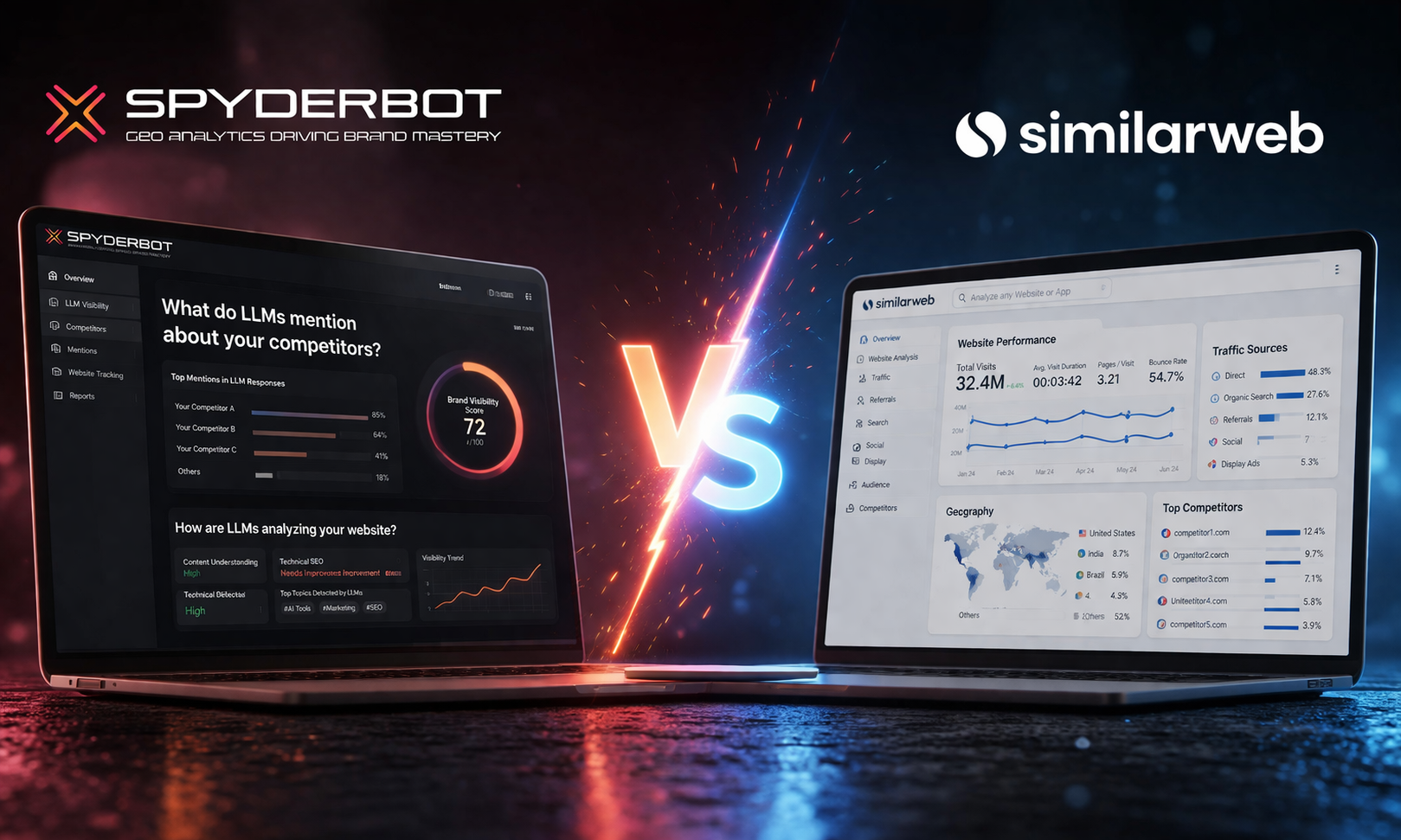
This is where the difference between Similarweb and SpyderBot becomes important.
Similarweb helps you understand where traffic comes from.
SpyderBot helps you understand what AI systems say before users click.
II. The simplest difference
Similarweb answers:
How are users reaching websites?
SpyderBot answers:
Is AI recommending, mentioning, or correctly understanding your brand?
These are not the same question.
Similarweb analyzes web traffic behavior.
SpyderBot analyzes AI-generated answers and LLM interpretation.
One looks at user movement across the web.
The other looks at what AI tells users before they make a decision.
III. What Similarweb is built for
Similarweb is a digital intelligence and traffic analytics platform.
It is mainly used to understand website performance, competitor traffic, market share, and acquisition channels.
Similarweb is useful for:
- Website traffic estimation
- Competitor traffic benchmarking
- Channel breakdown
- Organic search traffic analysis
- Paid search insights
- Referral traffic analysis
- Audience behavior
- Industry and market trends
- Digital market intelligence
For growth teams, SEO teams, investors, marketers, and strategy teams, Similarweb is valuable because it shows how users move across websites and digital channels.
If your goal is to understand traffic and market position, Similarweb is the right type of tool.
IV. What SpyderBot is built for
SpyderBot is a GEO analytics platform.
GEO means Generative Engine Optimization.
Instead of analyzing traffic, SpyderBot analyzes how AI systems interpret, mention, compare, and recommend brands.
SpyderBot helps answer questions such as:
- Does ChatGPT mention your brand?
- Does Gemini understand what your company does?
- Does Claude recommend your competitors instead of you?
- Is your website being interpreted correctly by LLMs?
- Which brands appear most often in AI-generated answers?
- What does AI say about your category?
- Is your brand missing from important AI prompts?
- How stable is your AI visibility across different questions?
This matters because AI visibility is becoming a separate layer of digital visibility.
A user may never visit a comparison page if an AI system already recommends a competitor first.
V. Traffic visibility vs AI visibility
The biggest mistake is assuming traffic equals influence.
It does not.
A website can receive traffic and still lose the decision layer.
For example, a company may have:
- Strong monthly visits
- Good referral traffic
- Strong organic search performance
- Healthy market share
- Good brand awareness
But when users ask AI tools for recommendations, the company may not appear.
That means the company has traffic visibility, but weak AI visibility.
Similarweb helps identify the first problem.
SpyderBot helps identify the second.
VI. Comparison table
| Category | Similarweb | SpyderBot |
|---|---|---|
| Main focus | Website traffic analytics | AI visibility analytics |
| System analyzed | User behavior across websites | AI systems and LLMs |
| Core data layer | Visits, channels, engagement | Mentions, prompts, AI answers |
| Main question | Where does traffic come from? | What does AI recommend? |
| Best for | Market and traffic intelligence | GEO and AI brand visibility |
| Competitor analysis | Traffic-based competitors | AI-recommended competitors |
| Output | Traffic insights | Answer-level insights |
| Visibility layer | Website acquisition | AI-generated decision layer |
VII. Where Similarweb is stronger
Similarweb is stronger when your goal is digital market intelligence.
Use Similarweb when you need to:
- Estimate competitor traffic
- Compare website performance
- Understand acquisition channels
- Analyze market share
- Study referral sources
- Track category trends
- Evaluate digital growth
- Understand audience behavior
Similarweb is especially useful when you want to know how users arrive at websites and which digital channels are driving growth.
SpyderBot does not replace this.
VIII. Where SpyderBot is stronger
SpyderBot is stronger when your goal is AI visibility intelligence.
Use SpyderBot when you need to:
- Track whether AI systems mention your brand
- Monitor competitor mentions in AI-generated answers
- Understand why AI recommends another company
- Analyze how LLMs interpret your website
- Identify missing brand associations
- Measure prompt-level visibility
- Detect weak AI positioning
- Improve visibility in AI search and answer engines
This is a different kind of analytics.
It is not about traffic after the click.
It is about influence before the click.
IX. What Similarweb cannot show
Similarweb does not fully answer questions like:
- Does ChatGPT recommend my brand?
- Does Gemini mention my competitors more often?
- How does Claude describe my product?
- What does AI think my company does?
- Is my brand included in AI-generated buying recommendations?
- Why is AI ignoring my website?
- Which prompts make my competitors appear?
This is because traffic data does not show AI-generated answer behavior.
Similarweb can show where users go.
It cannot fully show what AI tells users before they go anywhere.
X. What SpyderBot cannot replace
SpyderBot does not replace Similarweb.
SpyderBot is not designed for:
- Traffic estimation
- Channel breakdown
- Audience demographics
- Market share analysis
- Referral traffic analysis
- Website visit benchmarking
Those are Similarweb’s strengths.
SpyderBot focuses on AI visibility, not traffic analytics.
The correct approach is not to replace one with the other.
The correct approach is to understand which visibility layer you are trying to measure.
XI. Real-world example
Imagine a SaaS company with strong traffic.
Similarweb may show:
- High monthly visits
- Strong organic search growth
- Good referral traffic
- Better performance than smaller competitors
- Strong category presence
From a traffic perspective, the company looks healthy.
But when users ask AI:
“What are the best tools for this problem?”
The AI answer may recommend competitors instead.
SpyderBot may reveal:
- The brand is rarely mentioned
- Competitors appear more often
- AI does not clearly understand the product category
- The website lacks strong entity signals
- The brand is not associated with key use cases
This is the hidden gap.
Traffic is not the same as AI influence.
XII. Why this matters now
The buying journey is changing.
Before, users searched, clicked, compared, and then decided.
Now, users often ask AI first.
That means AI systems can shape the shortlist before a user visits any website.
This changes the role of analytics.
Traffic analytics tells you what happened after users moved across the web.
AI visibility analytics tells you whether your brand was included before the user made a decision.
That is why GEO is becoming important.
XIII. How Similarweb and SpyderBot work together
The best teams should not treat Similarweb and SpyderBot as direct replacements.
They should treat them as tools for different stages of visibility.
| Layer | Question | Tool type |
|---|---|---|
| Market intelligence | How large is the opportunity? | Similarweb |
| Traffic acquisition | Where do users come from? | Similarweb |
| AI recommendation | Which brands does AI suggest? | SpyderBot |
| Brand interpretation | How does AI understand us? | SpyderBot |
| Competitive visibility | Who appears before the user clicks? | SpyderBot |
Similarweb helps you understand the traffic layer.
SpyderBot helps you understand the AI answer layer.
Both matter.
XIV. When to use Similarweb
Use Similarweb if your priority is to:
- Understand website traffic
- Benchmark competitors
- Analyze digital channels
- Study market trends
- Compare audience behavior
- Evaluate traffic growth
- Plan digital acquisition strategy
Similarweb is best for understanding web activity and market-level performance.
XV. When to use SpyderBot
Use SpyderBot if your priority is to:
- Improve AI visibility
- Track LLM brand mentions
- Monitor AI competitor recommendations
- Understand how AI interprets your website
- Identify missing brand signals
- Improve GEO strategy
- Measure prompt-level visibility
- Know whether AI includes your brand in answers
SpyderBot is best for understanding how AI systems represent your brand.
XVI. Should companies use both?
Yes.
Most serious marketing teams will need both traffic analytics and AI visibility analytics.
Similarweb helps answer:
Where is our traffic coming from?
SpyderBot helps answer:
Are we being recommended before users even visit a website?
Those two questions support different decisions.
Traffic matters.
But AI recommendation is becoming a new source of influence.
XVII. Final conclusion
Similarweb is a strong platform for traffic analytics, market intelligence, and competitor benchmarking.
SpyderBot is built for a different problem: understanding AI visibility, LLM mentions, competitor recommendations, and how AI systems interpret your brand.
The difference is simple.
Similarweb shows how users move across the web.
SpyderBot shows what AI tells users before they move.
In the old digital model, visibility meant traffic.
In the AI-driven model, visibility also means being included in the answer.
That is why brands should measure both traffic visibility and AI visibility.